|
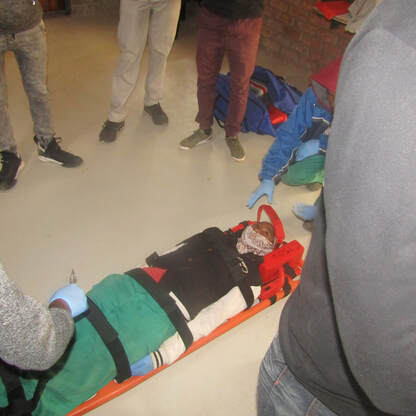
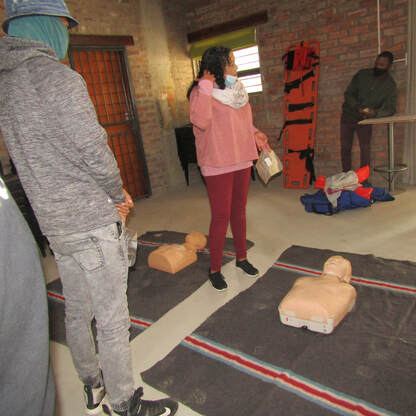
Participants of the working for water programme, which focuses on the clearing of alien vegetation, completed first aid level 1 as well as health and safety training last week. The training was facilitated by Verity Arends from Coalition Training and Skills Development. The trainig involved 12 participants for both first aid as well as health and safety and both courses were set out over two days and included practical and theory and were held at the new Shed at Strawberry Hill Farm. 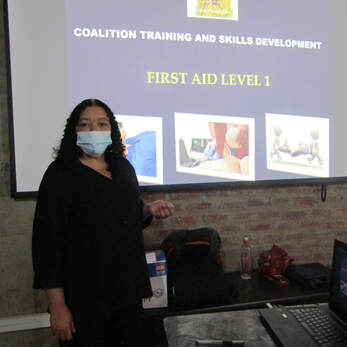 Verity Arends from Coalition Training and Skills Development facilitating the courses The sessions started at 8am in the morning and ended at 4pm in the afternoon, including a lunch break. The participants strongly engaged in the practical aspects, where they had to perform CPR on dolls, and practice using the stretcher and wearing protective clothing, such as gloves. The outcomes that the learners needed to be able to perform after this training, included understanding emergency situations and treating injuries in the workplace and demonstrating knowledge of hazards, safety and emergency procedures in forestry operations and explaining preventative measures in the workplace.
The enthusiasm of the learners was high throughout the first aid as well as health and safety. They enjoyed listening to everyone’s stories and experiences in the workplace as they are not from the same teams and they hardly knew each other but could speak about common challenges in the workplace. They were able to give each other possible solutions and discuss what works for certain teams and what doesn’t. As the student attending the training, I was encouraged by the stories told and how people spoke from the heart. For example, there was someone who had recently had a heart transplant and was still working and there was someone who had injured his hand with a chainsaw, while working elsewhere. The teams were aware of the hazards for the people on the ground. Going back into the field as safety representatives or first aiders, they knew they had a responsibility towards the team, not only to be available for whenever an incident occurs, but also to inform and educate their team members so everyone is safe. In addition to all that was learnt, it was lovely to get to know the people in the teams. To hear what they face in the workplace, to hear them ask questions, engage and want to educate and better themselves and to develop their skills.
0 Comments
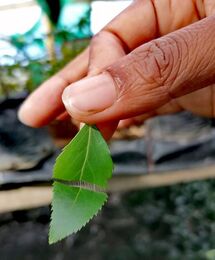
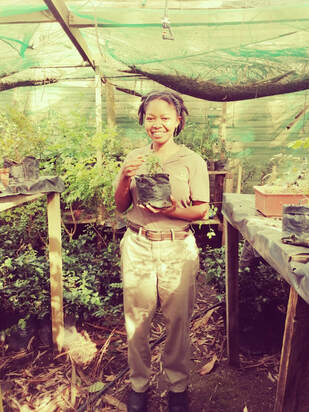 Zaniel in the nursery with her favourite tree Zaniel in the nursery with her favourite tree Maytenus acuminate occurs from the Zambezi River to the Western Cape. It is wide spread in the our conservancy with many young trees in our nursery. The name acuminate refers to the tapering point of the leaves. You can plant this tree in full sunlight or light shade. If you want to plant this tree from seed, collect the seeds when the capsules when they are splitting and revealing the orange fruit. You can remove the soft aril by washing the fruit in clean water. The remaining seed is small and should, preferably, be sown when fresh and during the warm summer months when the plant is in active growth. You can use well rotten compost to ensure good growth. The species can also be propagated from cuttings but take the cutting in the spring. "This is my favourite tree as it’s a beautiful garden plant and has lovely, reddish brown bark." says Zaniel. "When I came for my interview at the gvb office, this was the first tree that Oom Twakkie (Goliath Highburg) showed me. It caught my attention. I was fascinated by the elastic threads on the broken leaf and I now instantly know what tree it is. Crazy interesting." http://pza.sanbi.org/maytenus-acuminata-var-acuminata-silky-showers
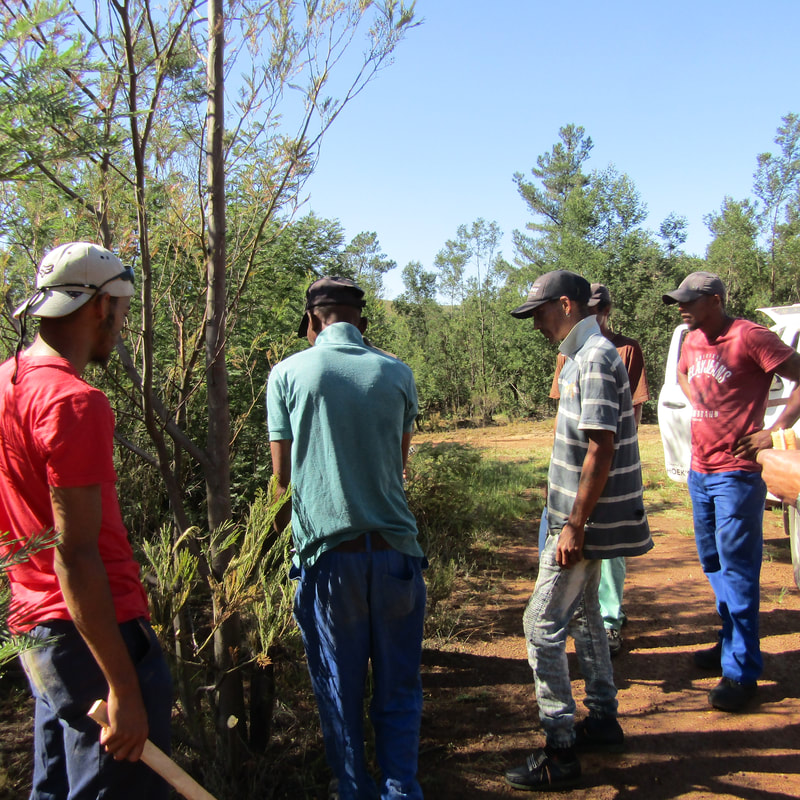
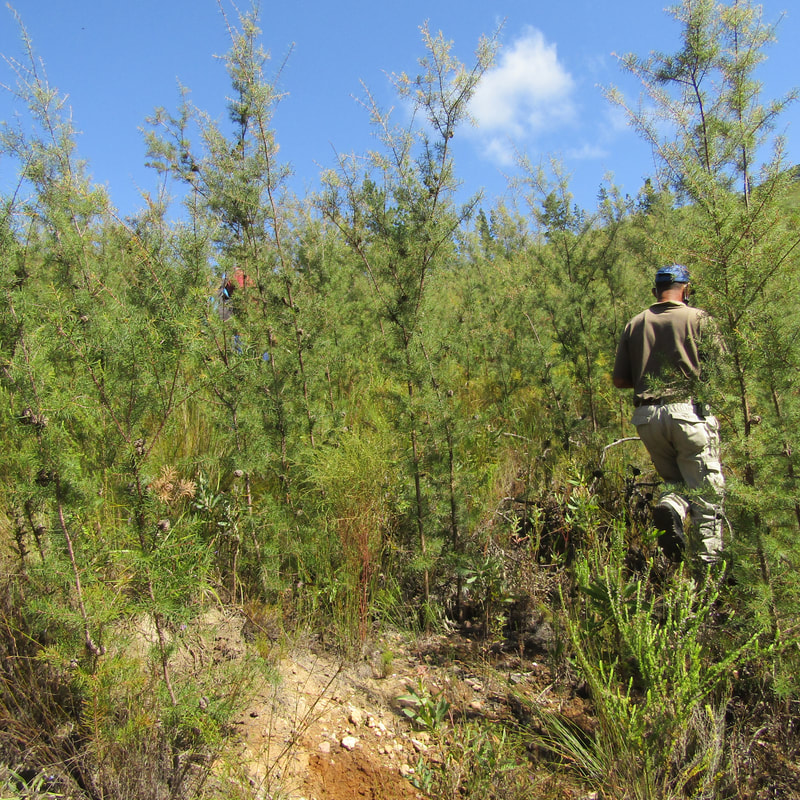
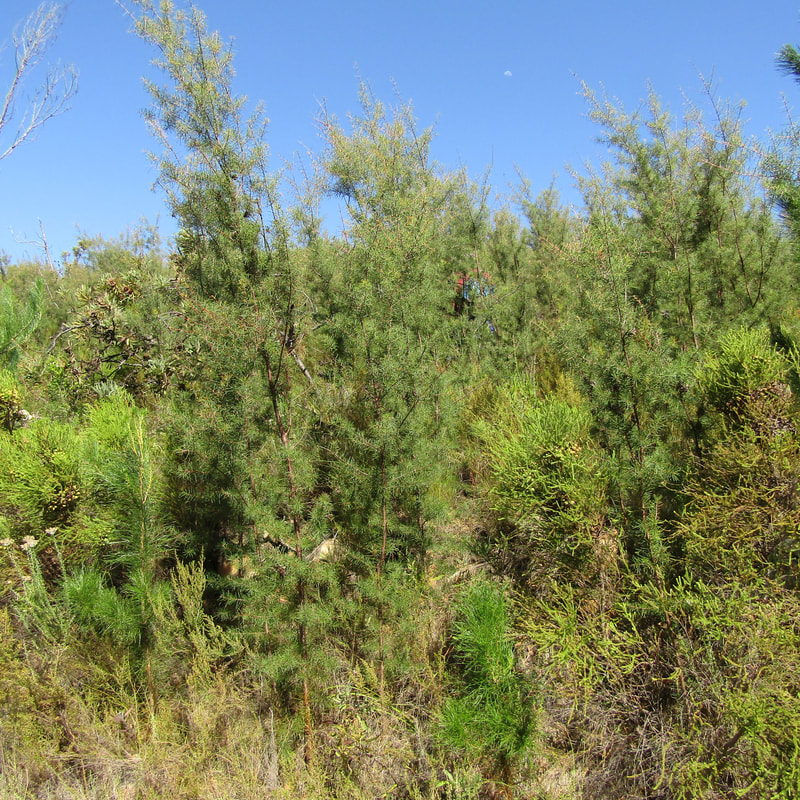
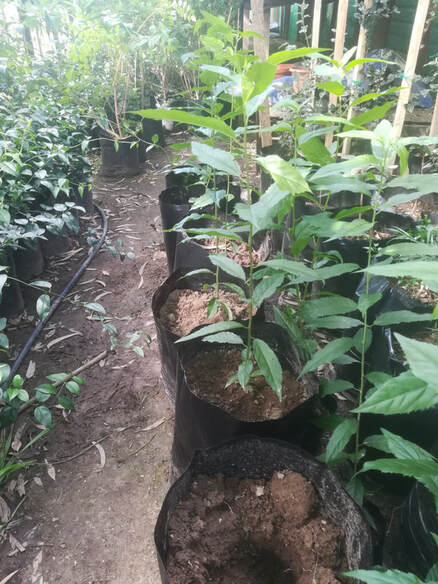
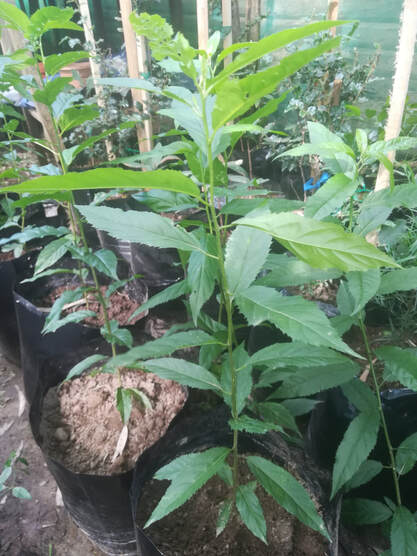
Van Wyk, B., 2013. Field guide to trees of southern Africa. Penguin Random House South Africa. Last week, some team members went to the mountains above Suurbraak to apply a biocontrol agent to invasive hakea trees. Silky hakea (Hakea sericea) is an evergreen tree with very prickly leaves. It invades mountain fynbos as well as coastal grassland. A native of Australian, it was once cultivated for dune cultivation and hedging. Hakea trees usually grow fast and produce a lot of seeds. They form large stands and seeds can be transported by the wind for long distances, and new infestation develop quickly in neighbouring valleys. There are large infestations in the coastal mountains of the Cape floral region in the Western Cape. Many infestations occur in remote or inaccessible areas and so invasions can become extensive before they are noticed. A further challenge is that fire increases the prevelance of the population. For remote mountainous areas, bio control is most effective. Regular follow up is also always essential to keep the aliens in check. Biocontrol makes use of a plant's naturally occurring enemies to reduce the invasive impact of a species. There are many different bio control agents that can control hakea but we used an indigenous fungus that has successfully been used to control hakea. The biocontrol was applied to the adult trees by spraying it on to an exposed wound which was made with a simple, custom-made tool (a plank with exposed nails). 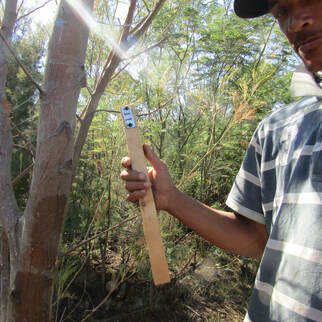 We came across quite a few hakea trees in the Suurbraak mountains and we needed a few days work to apply the agent effectively. The fungus will spread naturally, especially if there is a lot of rain following its application. Over a few years, fungus will slowly kill the trees."You will see how beautiful the fynbos will come out, once all the aliens have been cleared" says oom Twakkie (Goliath Highburg, Guality Controller for the Conservancy). We cant wait to start seeing the results! See the following link for more information on biocontrol options. biocontrol-agent-information.html References Gordon, A.J. and Fourie, A., 2011. Biological control of Hakea sericea Schrad. & JC Wendl. and Hakea gibbosa (Sm.) Cav.(Proteaceae) in South Africa. African Entomology, 19(2), pp.303-314. This week, in our nursery we reported Kiggelaria Africana (wild peach). Kiggelaria Africana is a medium sized tree and occurs in the forest wooded riverine or on rocky outcrops and grassland. The wild peach is a well-known tree on the conservancy and Goliaith Highburg (Oom Twakkie) usually plants it successfully from seed. It grows very well in the bags he has in the nursery.
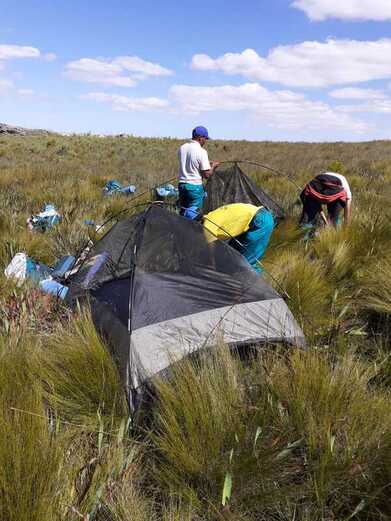
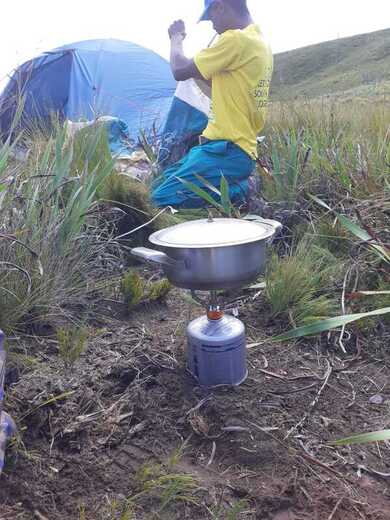
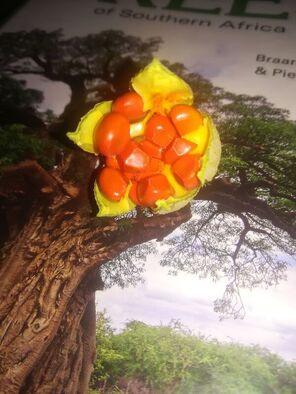 Bright orange seeds of the Wild peach tree(Kiggelaria africana) Bright orange seeds of the Wild peach tree(Kiggelaria africana) On the conservancy, Oom Twakkie obtains seeds and plants them in pots or bags with compost with the sprayers to water them in the nursery. The fruit is round, yellowish green and covered with hairs. The seeds are black, with a bright red orange covering and yellowish green flowers. An interesting fact is that bats are the main pollinators of this tree. It thrives on the edges of forests and is often encountered in kloofs and rocky outcrops of grass-covered mountain slopes. It is found between moist slopes above the Riversdale coastal plain and areas like Zuurberg that experience mostly summer rainfall. ''It's one of my favorite trees" says Aileen Anderson, the manager of our conservancy. And indeed the wildpeach tree that stands on her deck is magnificent, with round balls and bright orange seeds inside. The tree sits above the best celphone reception for Aileen's office so this wise tree has overheard many interesting conservancy-related conversations. The birds also love it and so Aileen's deck is always filled with busy birds. This beautiful tree is named after Franz Kiggelaer and the Latin word africana means "comes from Africa".The hardish pink-brown wood can be used for timber (furniture). It was also once used for the wagon spokes of ox wagon wheels. Some people believe that touching this tree will attract lightning. In South Sotho culture, medicince is made from it to protect kraals. The fruit is also toxic and used for traditional medicine such as skin problems. An extract of the bark can be used for treating sores and wounds and the seeds were eaten during famine. What a useful tree! Oom Twakkie says that you just plant the seeds into your compost soil and they grow. Young trees grow fast as observed in the nursery and they flower from about two years old. It forms a good windbreak for your property. When you plant the trees, Omm Twakkie recommends using moderate amount of water and a place in the sun. Another tip is to add your compost to the soil when planting and the tree grows in both winter as well as summer rainfall. This tree attracts birds and butterflies .This lovely pioneer plant will also feed your honeybees. Wow...What an amazing tree! We are lucky to have this species here on our conservancy. 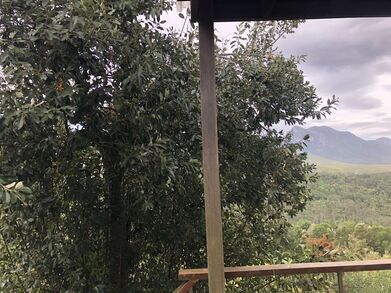 Showing the Kiggelaria africana on Aileen's deck References: http://pza.sanbi.org/kiggelaria-africana Van Wyk, B., 2013. Field guide to trees of southern Africa. Penguin Random House South Africa. In early February, 14 beneficiaries, climbed the Langeberg mountain on the west side of the Grootvadersbosch Conservancy to do alien clearing. They were divided into two separate teams, called the Pine and Hakea Teams. The initiative is funded by landowners and the Department of Environmental Affairs Forestry and Fisheries, under the Natural Resource Management (NRM) programme. 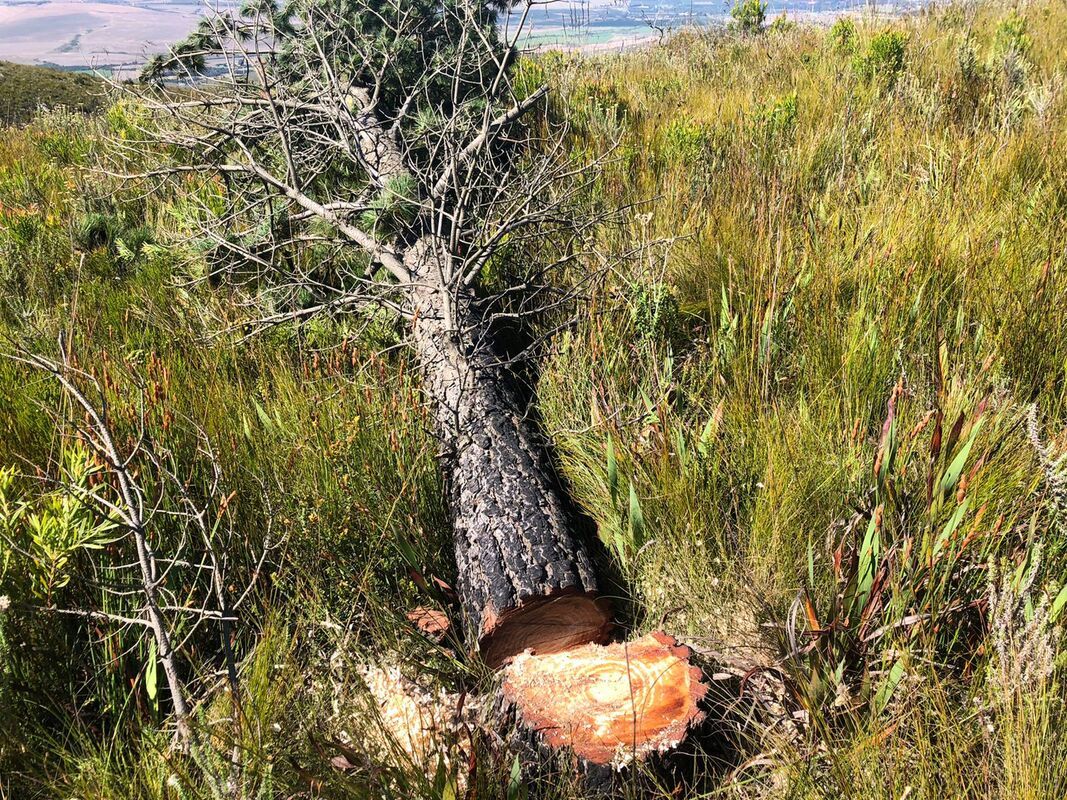 Alien vegetation cut down by the team members Alien vegetation cut down by the team members The teams were assigned equipment, which included sleeping bags and tents. The aim of their assignment was to remove the alien invasive trees (mainly hakea, pine and some black wattle) in a specific block, reflected in their contracts. The teams walked approximately 17km up the mountain, with an elevation gain of 480m to an altitude of 1145m. The first two blocks, covered 1157 hectares. The work was made more strenuous because they had to manoeuvre around with their overnight camping equipment. The participants have all received training to prepare them for the work. 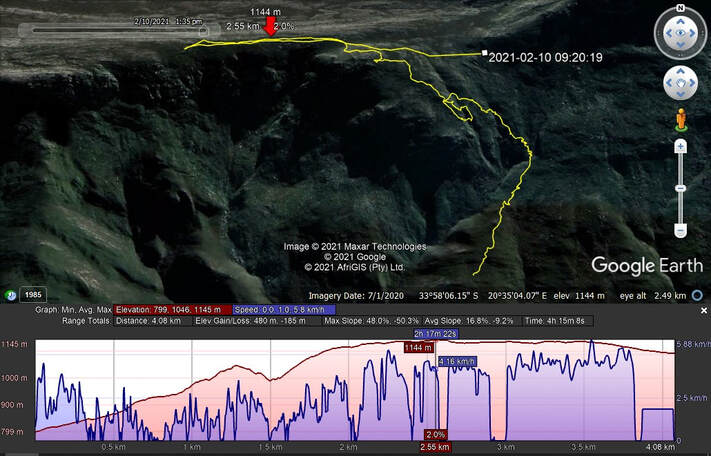 Map showing the distance the team walked and where the first block needs to be cleared. The teams were camping for 4 nights in the mountains. They go up on a Mondays and descend on Fridays. The first two contracts stretch over 3 weeks in which they have to go up and camp in the mountains each week. Overall, the participants were eager to sleep out and tackle this important work. 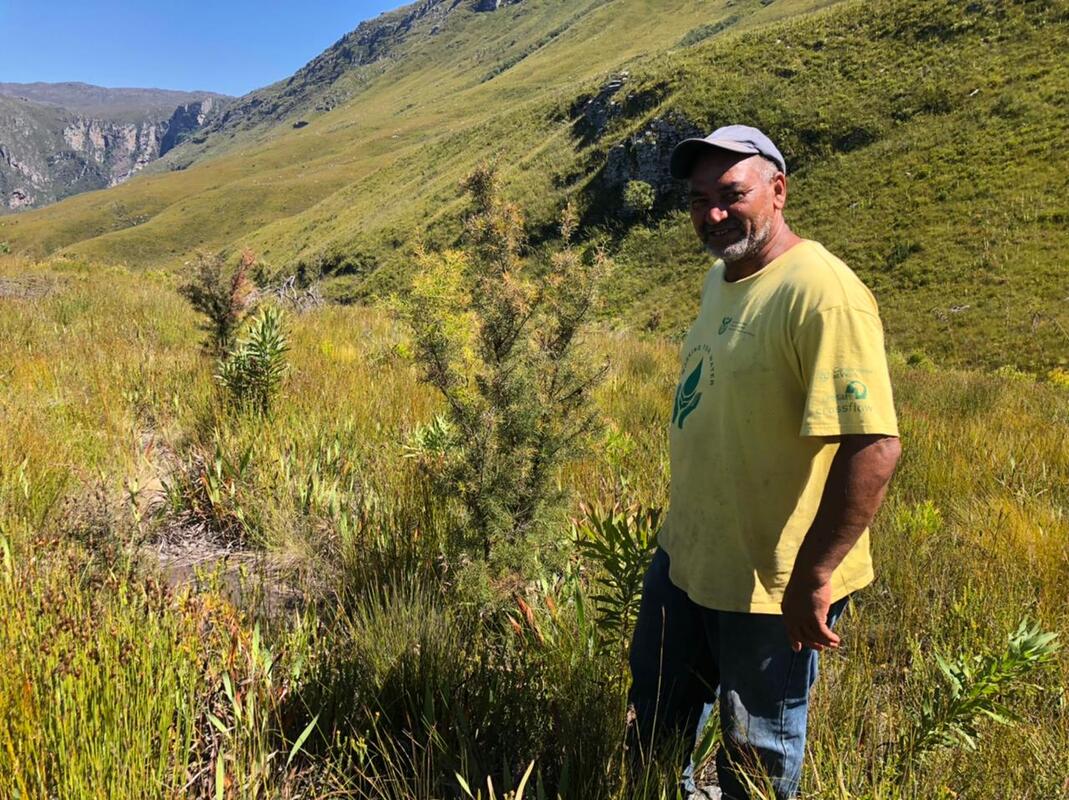 One of the contractors, Vernon Wessels, on his way up the mountain with invasive hakea plants in the background Vernon Wessels and Wayne Fielies are the two contractors, each with the responsibility to guide their teams. Each team has the contractor to give overall instructions for the contract, as well as a supervisor in the field to look after the team. One of challenges that the team faced was that it was hot, other challenges included the danger of the terrain and the equipment that they must carry. For safety, they had to be able to communicate daily with the office to ensure that they remained safe in the field. Covid 19 regulations and protocols is also a challenge because of social distancing, as the teams needed to sleep in tents in the mountains. Regardless of the challenges, the two teams was very brave and committed to reach the top of the mountain and neither the weather nor anything else could stop them. The teams will complete the 2 contracts within 3 weeks and will be working on other contracts until the end of March.
''This is a great experience for me" said one of the team members when they needed to go back into the mountains. Overall, it seems that the teams are well organized and are motivated to complete this important work to protect our precious mountain environments. |
AuthorGVB Conservancy Staff Archives
May 2024
Categories |

 RSS Feed